
Designing Cable Tray Expansion Joints for 50 °C Rooftop Runs in the UAE: Spans, Hangers, and Thermal Drift
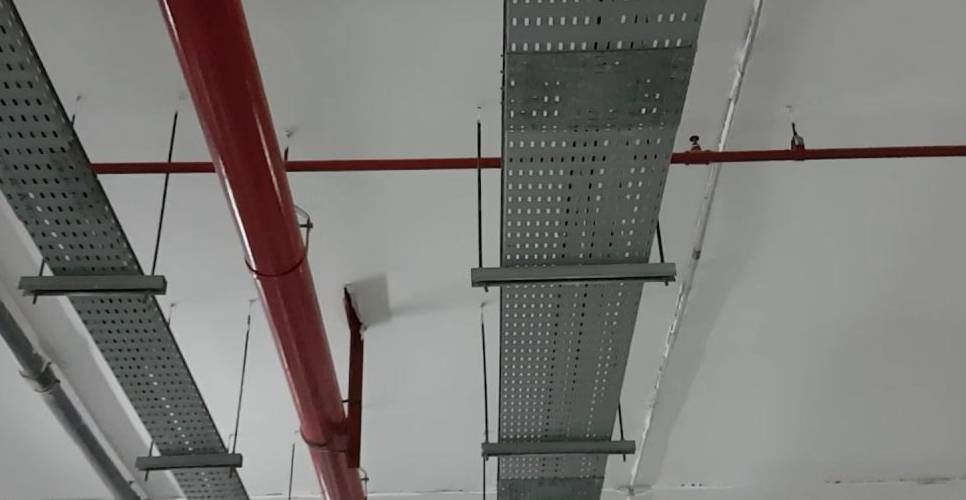

In the Gulf, cable tray design is never just about routing power from point A to point B. On UAE rooftops, where exposed metal routinely reaches 50 °C and beyond, cable trays behave less like static supports and more like long mechanical members under constant thermal stress, a condition well understood by experienced cable tray manufacturers in uae operating in desert climates. Ignoring this reality has led to warped trays, elongated bolt holes, failed supports, and in extreme cases complete system separation. Expansion joints are not optional accessories here; they are structural necessities.
Thermal Expansion
Steel expands approximately 12 µm per meter per degree Celsius. On a 40-meter rooftop tray run, a temperature swing from a mild 20 °C installation morning to a 55 °C summer afternoon introduces nearly 17 mm of linear movement. Aluminium trays move almost twice that amount. Multiply this across multiple spans restrained by rigid hangers, and the result is predictable: stress accumulates until the system deforms.
Standards bodies have long acknowledged this. NEMA VE-1 provides maximum allowable tray lengths between expansion joints approximately 39 m for steel and 20 m for aluminium under a 55 °C differential. Yet site audits across the UAE still show rooftop trays installed continuously across 60–80 m without a single expansion splice, often anchored rigidly at every support. The failure is not theoretical; it is systemic.
Expansion Joints Are Only As Good As Their Supports
A common misconception is that installing an expansion joint alone “solves” thermal movement. In practice, the joint is only one element in a controlled-movement system. Without proper support logic, it becomes a decorative weakness.
Best practice requires:
- One fixed (anchor) support per expansion zone
- Guided supports elsewhere, allowing axial movement but restricting lateral and vertical displacement
- Supports located within 600 mm on either side of the expansion joint
When trays are clamped rigidly at every hanger as is still common in value-engineered installations the expansion joint cannot function. Instead, the tray “snakes” between supports, transferring stress to splice bolts and side rails. Field data from GCC industrial projects shows that over 70% of tray deformation issues originate not from missing joints, but from incorrect hanger restraint philosophy.
Span Lengths Under Heat: Shorter Is Smarter
Rooftop trays experience not only thermal movement but reduced material stiffness due to elevated temperatures. Steel loses measurable yield strength above 40 °C, while aluminium softens even earlier. As a result, manufacturer-rated span tables often based on 25–30 °C ambient conditions become optimistic.
Experienced designers in the UAE derate rooftop spans by 15–25%, particularly for heavily loaded power trays. For example:
- A ladder tray rated for 3.0 m indoor spans is often limited to 2.2–2.5 m outdoors
- Expansion joints should never coincide with maximum span midpoints
- Splice locations perform best at ¼-span positions, reducing bending stress
These adjustments are rarely mandated by code, but consistently validated by post-installation inspections.
Bonding Across Movement: The Electrical Blind Spot
Mechanical flexibility must never compromise electrical continuity. Expansion joints interrupt metallic paths, requiring bonding jumpers sized for full fault current, not merely signal continuity. This is frequently overlooked.
In high-fault environments data centers, substations, solar inverters, undersized bonding across expansion joints becomes a latent safety hazard, particularly when additional cable tray accessories are retrofitted during later system upgrades. NEMA guidance recommends bonding conductors equivalent to the tray’s side-rail fault capacity, ensuring future circuit upgrades do not silently exceed bonding limits.
Why UAE Rooftops Are A Special Case
Unlike temperate regions, the UAE combines:
- Extreme daytime heat
- Rapid night-time cooling
- Direct solar radiation
- Long, unobstructed tray runs
These conditions create daily expansion-contraction cycles rather than seasonal ones, accelerating fatigue at splice points. Data from regional facility managers suggests rooftop tray systems without expansion joints exhibit visible deformation within 24–36 months, compared to over 10 years for properly detailed systems.
Designing For Movement Is Designing For Longevity
Expansion joints should be viewed not as corrective devices but as deliberate design features integrated from the layout stage. Their placement affects hanger spacing, bonding strategy, and even procurement decisions. When coordinated correctly, they reduce maintenance costs, extend tray life, and eliminate a class of failures that inspections routinely miss.
In the UAE’s climate, thermal drift is not an exception; it is the default operating condition. Engineers who design as if trays are static structures are designing for failure. Those who treat them as dynamic systems, allowed to move predictably and safely, deliver installations that endure both heat and time.